


# Bussines Development
IT Outsourcing Models: How to Choose the Right One?

TL;DR
⚡ Quick Summary:
Choosing the right outsourcing model depends on your project's flexibility and budget:
- Staff Augmentation: Best for filling specific skill gaps in your existing team.
- Dedicated Team: Ideal for long-term projects with evolving requirements.
- Fixed Price: Best for small, well-defined projects with a strict budget.
- Time & Material: Most flexible for R&D and scaling startups.
Have you ever wondered how many specialists there are in the software development industry? More than 25 million people worldwide help create, manage, and develop new products. However...even such a wide variety of options can sometimes make the final choice difficult.
For example, small startups and companies often choose to turn to outsourcing experts instead of hiring an internal team. And here you may have a logical question about how to choose the right outsourcing model and what you need to do for that. In this article, we would like to tell you more about outsourcing in the field of software development, the existing types and models, and provide a step-by-step guide to making your final choice!
What Is IT Outsourcing?
IT outsourcing refers to the outsourcing of certain technology-related functions, or the entire IT function, to another service provider. It helps companies to gain specialized knowledge, lower the cost of doing business, and put internal teams to work on key business objectives. Software development, infrastructure management, cybersecurity, technical support, or cloud services can be outsourced, depending on business requirements.
What else? Organizations contract with vendors who already possess the necessary skills, tools, and processes rather than construct and maintain everything internally. The strategy enables companies to grow faster, adapt to market changes, and maintain high-quality IT operations without incurring the substantial overhead costs associated with full-time staffing and training.
Types of IT Outsourcing Models
As you may have already understood, outsourcing is a fairly broad concept. There are actually several types of IT outsourcing models that you should be aware of. This will serve as a solid foundation if you are looking for new specialists for your project!
Location-Based Outsourcing Models
The models of location-based outsourcing are characterized by the geographical location of the service provider in relation to the client. This decision directly impacts costs, communication speed, overlapping time zones, and cultural alignment. Here are the main options:
- Onshore outsourcing = vendor based in the same country.
- Nearshore outsourcing = an approach whereby teams in adjacent or close nations are worked with.
- Offshore outsourcing = cooperating with companies in remote areas.
The selection of the appropriate location model is based on the project's complexity, the need to collaborate, and the available budget.
Relationship-Based Outsourcing Models
Relationship-based models determine the level of integration of the external team with your internal processes. These models are flexible, controllable, and long-term commitment, thus applicable to diverse business situations. We can highlight these options:
- IT staff augmentation = a service where outside experts come to your team to bridge any knowledge and skill gaps, while you maintain full control.
- Dedicated team model = fully allocated team on your project, working under the same management.
- Project-based model = well-defined project with a definite scope and tasks.
The right relationship model relies on the level of short-term expertise required, the software development capacity required, or a turnkey solution.
Pricing-Based Outsourcing Models
Pricing-based models help determine how costs are computed and how risks are shared between the client and the vendor. The appropriate pricing structure is considered the best way to keep the budget within limits and to guarantee the quality of projects and their responsibility.
- Fixed-price model = fixed budget of a project with a well-defined scope.
- Time and materials model = compensation according to the hours and resources.
- Incentive-based model = compensation is pegged on performance measures or results.
- Shared risk-reward model = interests are both aligned as financial risks, and rewards are shared by both parties.
The best pricing model will be based on the stability of the requirements, the risk tolerance, and the desired degree of cooperation.


IT Outsourcing: Key Factors
Many factors influence the choice of outsourcing model. You should consider each of them to ensure that your choice meets your requirements and the specifics of the project. Let us tell you about the key factors of outsourcing in the field of software development.
Business Goals and Needs
Companies need to know what they desire to accomplish before deciding on which outsourcing strategy to adopt. Other businesses focus on avoiding expenses, whereas others focus on delivering quickly, having access to niche knowledge, or scalability. Focus areas help identify the appropriate model, the type of engagements, and the extent of vendor involvement.
Project Requirements and Complexity
The outsourcing model decision is greatly influenced by project scope and technical complexity. Clear, consistent requirements are suited to structured models, and complicated or changing projects need flexibility and tight cooperation. Other considerations ought to be looked into at an early stage to prevent delays, rework, and unrealistic expectations.
Budget and Pricing Model
Budget constraints directly impact the decision on the outsourcing model and region. The fixed budget type is best suited to predictable pricing systems, whereas dynamic projects are well-suited to flexible costs. Businesses are advised to evaluate the hourly rates and the hidden expenses.
Time Zone and Communication
Time zone alignment influences teamwork, reaction, and general performance. It is projects that need a lot of meetings and on-the-fly feedback that do well in terms of overlapping work-hours. Effective communication patterns, identified reporting lines, and sound language skills are essential in the reduction of misinterpretations.
Level of Control and Flexibility
Various forms of outsourcing provide dissimilar levels of process control, priorities, and team management. There are businesses that like to be involved, and others that prefer to stay out and leave all the responsibility to the vendors. The appropriate balance between control and flexibility will be determined by internal expertise, risk management, and the company's ability to adapt to new demands.
How to Choose an IT Outsourcing Model?
Without any doubt, the right IT outsourcing model will help you save money and bring you closer to achieving your goals. Now you know about the key factors, types of IT outsourcing models, and much more. So, how do you choose the right IT outsourcing option? Below, we have prepared a comprehensive step-by-step guide for you!
Step 1. Define Your Business and Project Needs
It all starts by understanding what you really need. This consists of business, technical, timeline, and success measures. Knowing accurately whether you require faster delivery, cost reduction, access to expertise, or long-term scalability will reduce the number of models that fit in the first place.
So, you should identify the scope, major deliverables, and constraints at the project level. The better you structure your needs, the more easily you can find the right outsourcing strategy and avoid misalignment in the future.
Step 2. Assess Internal Resources and Gaps
Evaluate what you already have in your team. We mean the skills, capacity, and experience that you possess. Demonstrate deficiencies in expertise, bandwidth, or technology that slow down delivery or operational risk. This will save you money on services you do not need.
Knowledge of the internal constraints can also be used to identify the extent of outside penetration. The number of specialists required will depend on the extent of control and responsibility your organization can carry out.
Step 3. Compare Outsourcing Models
When needs and gaps are identified, compare outsourcing models based on their structure, level of engagement, and collaboration style. Location, relationship, and pricing models cannot be considered individually but rather as a whole. All combinations yield different trade-offs among cost, control, and flexibility.
Pay attention to the way each model can facilitate your work process and decision-making. A model that is effective in a short-term project does not necessarily work in a long-term product development.
Step 4. Evaluate Risks and Cost Efficiency
Risk assessment goes beyond pricing! What do we mean? Consider data security, compliance, vendor reliability, communication challenges, and dependency risks. Lower upfront costs may lead to higher long-term expenses if quality or delivery suffers.
Cost efficiency should be evaluated in terms of total value, not hourly rates. So, look at productivity, speed to market, and the vendor’s ability to adapt to changes. A slightly higher investment can reduce risks and deliver stronger business outcomes.
Step 5. Select the Model That Fits Your Goals
The final choice should directly support your strategic goals (and not just immediate project needs). The next step is to select a model that aligns with how your business plans to grow, scale, or innovate over time.
Before committing, validate the model through pilot projects or phased engagement. This approach reduces uncertainty, allows performance evaluation, and ensures the outsourcing model delivers measurable value aligned with your expectations.
IT Outsourcing vs In-House Team
When talking about software development and team expansion, there are several options to consider. The most common ones are, of course, various IT outsourcing models and hiring employees for the internal team. Which is better and in what situations?
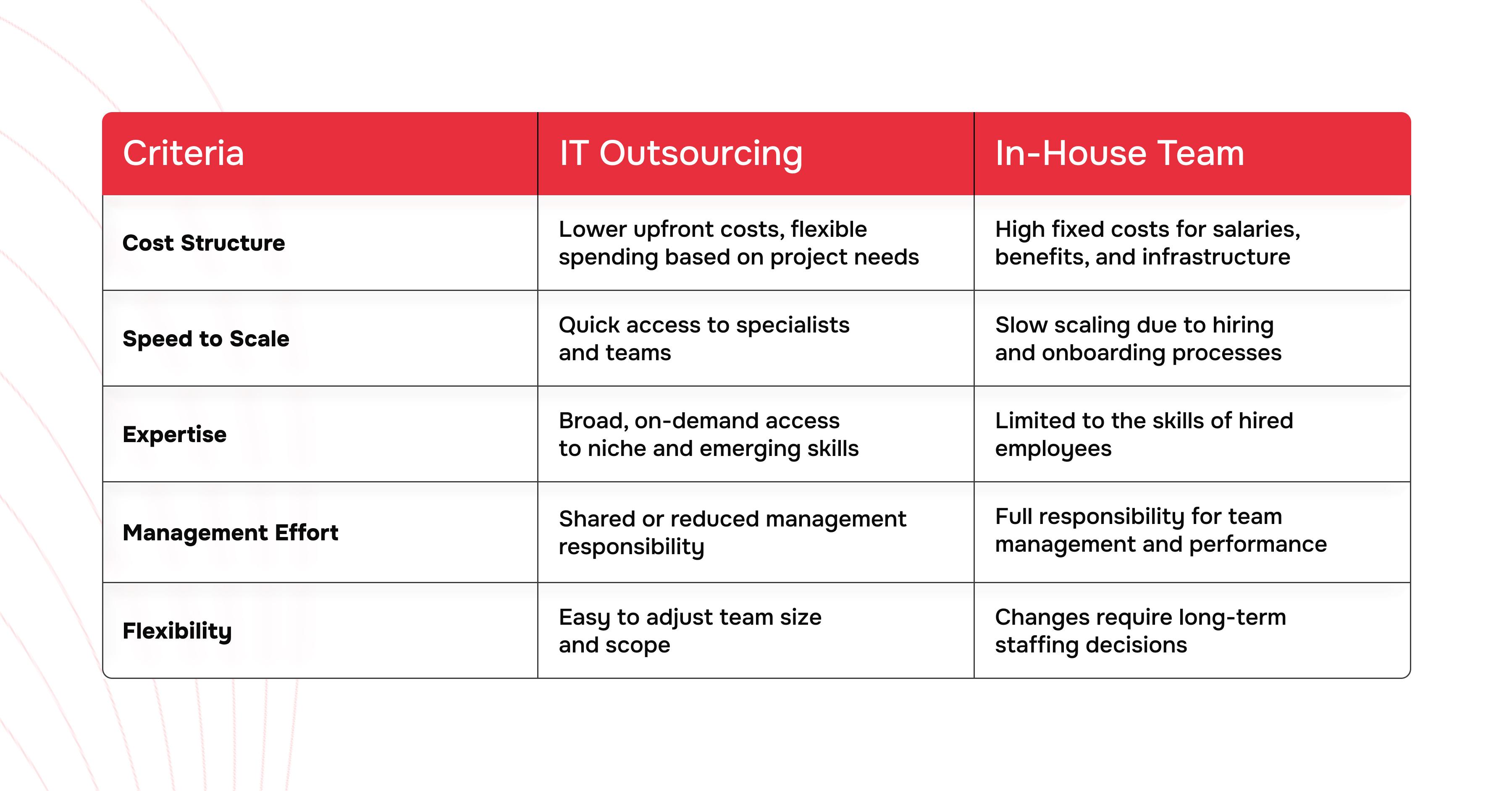
It is difficult to choose a winner in this comparison. Why is that? You should focus on your specific requirements and goals. For small and short-term projects, it is better to consider outsourcing, while large companies need stable internal employees.
Common Mistakes When Choosing an Outsourcing Model
Numerous outsourcing failures occur not due to poor vendors. This is the result of the weak decision-making at the initial stages. Companies tend to choose a model on assumptions. Thus, it renders a lack of correspondence between anticipations, duties, and actual performance.
- Focusing on low costs instead of value. When selecting the lowest cost, quality will be compromised, hidden costs will arise, and a lot of rework will be required, which will cost the company more.
- Lack of clarity of project scope and objectives. Unclear requirements lead to misinterpretations, scope creep, and time delays, particularly in fixed- or extended-model projects.
- The underestimation of internal participation. Even in outsourcing, there has to be planning, communication, and decision-making on the part of the client.
- Choosing an inflexible model. A model that cannot scale or be adapted will restrict growth and responsiveness to evolving business demands.
What should you do to avoid these mistakes? A cautious evaluation of the objectives, risks, and long-term implications will go a long way toward ensuring that the outsourcing model favours long-term results over operational stress.
How we help you choose at Red Rocket:
- Do you have a technical PM? If yes → Staff Augmentation.
- Is your scope 100% locked? If yes → Fixed Price.
- Are you building a core product? If yes → Dedicated Team.
Congratulations, because now you know more about outsourcing model options and how they can affect your work. The most important thing is to know how to make the final choice correctly. We recommend only contacting reliable companies when searching for new temporary specialists. For example, at Red Rocket Software, we provide information technology outsourcing services for projects in various niches and GEOs. We select technical talent specifically for the requirements of your project!
Frequently asked questions
What are the main IT outsourcing models?

Among the most common types of IT outsourcing models are location-based outsourcing options, relationship-based outsourcing models, and pricing-based outsourcing models.
How do I choose the right IT outsourcing model?

What is the difference between onshore, nearshore, and offshore outsourcing?
Is outsourcing better than an in-house team?
