


# Development
AIOps Explained: AI for IT Operations & Use Cases

TL;DR: AIOps combines AI and ML to automate IT operations. Key benefits: 60-80% reduction in alert noise, faster MTTR, predictive incident prevention. Best suited for enterprises with complex hybrid infrastructure managing 500+ alerts/day.
- Core Concept: The application of AI and Machine Learning to automate and enhance IT operations, performance monitoring, and incident response.
- Key Benefits: 60-80% reduction in alert noise, significantly faster MTTR (Mean Time to Resolution), and predictive incident prevention.
- Primary Use Case: Enterprises with complex hybrid or multi-cloud infrastructures managing high volumes of telemetry data (500+ alerts/day).
Any modern entrepreneur would like to automate most routine operations in the company. For large firms, this means reducing the workload on the in-house team and saving a significant portion of the overall budget. However, don't forget about AI operations, infrastructure, processing huge amounts of data, and other tasks. In this case, choosing a reliable AIOps solution designed for information technology is an excellent solution.
This artificial intelligence-based technology has only recently appeared and already has many striking AIOps use cases. Is it worth investing in the development of AIOps tools in 2025? How do such systems work? How can you benefit from this technology? Of course, you may have many questions in your head right now, and you want clear answers. That's why we want to lift the curtain and tell you more about AIOps in this article!
How Does AIOps Work?
First, we want to break down the term «AIOps» to make it clearer for our readers. It literally means Artificial Intelligence for IT Operations. Simply speaking, it’s the implementation of AI-based technologies for internal IT operations that most companies deal with every day. Although this technology also works on the basis of artificial intelligence, any AIOps platform can differ significantly from traditional systems. What do we mean by this?
The work of AIOps can be compared to a large conveyor belt, where there is a specific set of important algorithms. Each stage follows another, ensuring high accuracy of decisions and predictions. Properly configured AIOps solutions can collect, analyze, and sort data thanks to the features of artificial intelligence or machine learning. In simple terms, AIOps consists of specific blocks that have their own functionality and area of responsibility.
Key Benefits of AIOps
To obtain a ready-made AIOps platform tailored to your specific requirements and objectives, an investment is required. Is this solution worth the financial resources? To fully answer this question, it is best to take a closer look at the benefits of AIOps. Spoiler alert: your business will definitely benefit from this solution, as AIOps provides many advantages for modern companies. Let us tell you more about the most important AIOps benefits that everyone should know about!
Optimized Time & Budget
AIOps enables IT teams to automate the repetitive work of monitoring, analysis and troubleshooting, cutting the many hours that they spend on such manual tasks. It helps to spot anomalies in real-time and deliver actionable knowledge, so consequently, it reduces downtimes and speeds up response times. Such effectiveness makes sure that precious human resources are not spent on day-to-day incidents but are invested in strategic initiatives instead.
Financially speaking, this solution helps to reduce the necessary operational expenses. Maintenance of automated root cause analysis avoids any costly interruptions, whereas predictive analytics saves the organisation's use of resources. The outcome is a more intelligent IT budget where there is an investment in growth instead of wasteful recovery.
Amplified IT Performance
The environments of modern IT are getting more complex, and the conventional tools of monitoring fail to offer clarity. AIOps enhances system performance through the correlation of high volumes of data across the infrastructure, applications and networks. It spots performance bottlenecks prior to affecting users and suggests pre-emptive remedial action to preserve stability. This makes systems work at full efficiency even during heavy work times.
Moreover, AIOps is constantly learning through prior incidents. In the long term, it develops proactive models that enable IT personnel to preclude repeat failures and optimise the performance of a system.
Faster Path to Digital Innovation
Another benefit is confidence in deploying new applications, services or integrations without risking stability. Procurement of new digital solutions can be delayed because of issues related to reliability and operating risks. AIOps reduces this distance by making IT less brittle by establishing a more resilient IT backbone that can both support changes rapidly and respond to changes.
In addition, AIOps helps IT departments to stop being tied to reactive support with a chance to focus on innovation. This removes the fear of failure, shortens downtimes and simplifies work processes.
What are Some Examples of AIOps?
The best way to learn what an AIOps solution actually is is to look at existing examples. Their mechanism and purposes may vary depending on their type. Here are some popular examples of AIOps:
- An AI-powered Network Management System can continuously monitor switches, routers, and access points across a large infrastructure. When unusual latency or packet loss occurs, the system automatically detects the root cause and recommends corrective actions.
- In complex application environments, AIOps analyses logs, metrics, and user behaviour to detect early signs of performance degradation. For example, if an eCommerce app experiences slow checkout times, AIOps can identify the exact service causing the issue.
These AIOps use cases perfectly demonstrate how such technologies can be useful for modern enterprises of various sizes. The main advantage is that you choose how AI will help you cope with complex IT operations.


What Problems Can AIOps Help Solve?
Companies that deal with huge amounts of data every day, need to make predictions, create possible scenarios, and make important decisions, are well aware of common problems. Some mistakes at this level can be too costly, and that's where AIOps tools come in handy. Among the common problems that can be solved by AIOps, we can highlight:
- Incidents. Some incidents can be critical, and identifying them at an early stage is something that artificial intelligence can handle.
- Outages. Among the most common problems are outages, which can completely halt your company's workflow. Any AIOps platform helps ensure uninterrupted system operation.
Among other important aspects of AIOps, event correlation, routine task automation, and security stand out. These are important factors that AIOps includes in its work.
Types of AIOps Tools
Whereas AIOps tools typically can be characterised by two broad categories: domain-centric and domain-agnostic. Domain-specialised tools include those with functionalities to be used in a particular area of IT, like network monitoring, application performance or infrastructure management. Their strongest feature is that they are focused, i.e. offer fine-grained inferences and very specific anomaly detection in that particular domain.
Conversely, domain-agnostic instruments are to be constructed in such a way that they can be applied to analyze data of various IT domains simultaneously. They correlate data in the applications, networks, cloud environments and security systems to deliver a consistent enterprise-wide perspective of operations. Such a wide-angle view enables IT teams to rapidly spot cross-domain dependencies, address incidents more easily, and handle complex hybrid setups more efficiently.
Two Approaches to AIOps
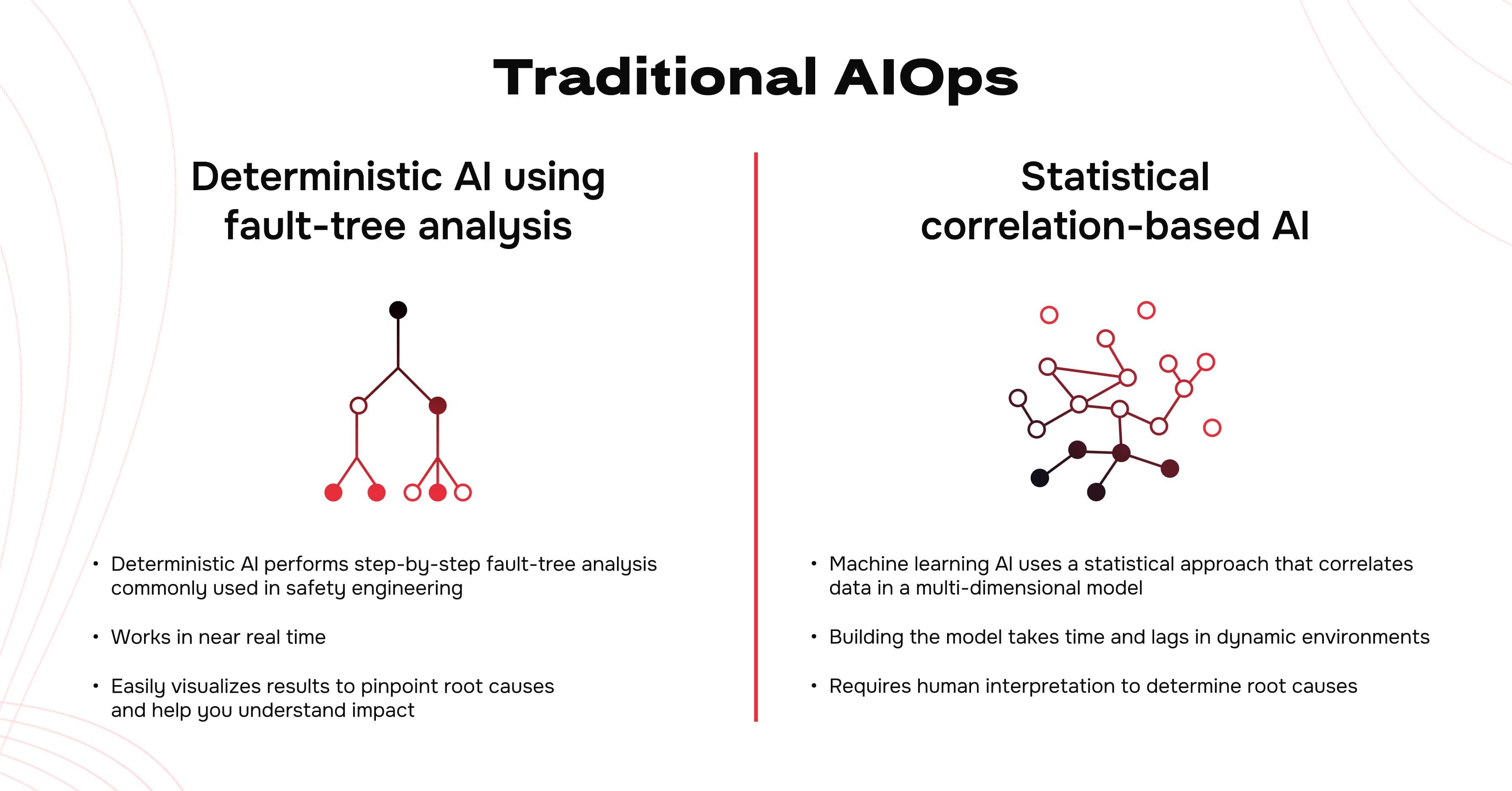
How AIOps work is determined by many factors, including their approach. Today, experts identify only two main approaches: traditional and contemporary. What is the difference between them? How do they work in real life? Let's take a look at the features of both approaches below!
Traditional AIOps
Conventional AIOps is generally heavily based on rule-based systems and fixed thresholds to identify anomalies. Although it can be very effective in an orderly world, it fails to meet the challenges of modern IT requirements. Such solutions are always manually tuned, which is not suitable for dynamic infrastructures where blistering fast change is the thing.
Contemporary AIOps
Modern AIOps employs artificial intelligence and natural language processing, advanced analytics in real-time to provide flexible intelligence. Rather than the use of static rules, it learns continually from new data and previous incidents, increasing its accuracy. This will allow predictive functionality, reduced time in root cause analysis and increased automation, making IT operations comparable to the pace of digital transformation.
AIOps Tools
To qualify as true AIOps tools, they must go beyond basic monitoring and provide advanced operational capabilities. They need to collect and normalise massive amounts of data from diverse sources, including applications, infrastructure, and networks. This data foundation enables the use of machine learning to detect anomalies, identify correlations, and predict potential failures before they disrupt business operations.
In addition, AIOps solutions should support automation at scale. From intelligent incident management to proactive remediation, they empower IT teams to respond faster while reducing manual workload.
Emerging Trends and Data in AIOps
The development of AIOps became more influenced by the achievements in artificial intelligence and the increasing complexity of the IT environment. One of the trends is the convergence of AIOps and observability platforms to provide further insights into the logs, metrics, and traces on a real-time basis. Another trend is the migration to predictive automation, where automation doesn't simply respond to an incident but disallows it altogether.
Data is also the key to the maturity of AIOps. Organisations brought data silos to data lakes, meaning that machine learning algorithms can ingest data sets that are wider and cleaner. This change increases accuracy in detecting anomalies and correlations.
AIOps Key Technical Insights (2025-2026)
- Primary Goal: To eliminate "monitoring fatigue" by using ML models to filter out non-critical alerts.
- Core Technologies: Big Data, Machine Learning (Supervised/Unsupervised), Natural Language Processing (NLP) for log analysis, and Automated Causal Analysis.
- Implementation Timeline: > * Phase 1 (Data Integration): 2-4 weeks.
- Phase 2 (Model Training): 1-2 months.
- Phase 3 (Full Automation): 3-6 months.
- Key Performance Indicators (KPIs) improved by AIOps:
- MTTD (Mean Time to Detect): Reduced by ~50%.
- MTTR (Mean Time to Resolution): Reduced by ~40-60%.
- System Availability: Increased to "four nines" (99.99%).
As you may have already understood, having an AIOps platform is a competitive advantage for companies that work with large amounts of data or own their own IT infrastructure. Such a solution optimizes time and budget, provides a fast track to digital innovation, and automates many processes. Are you inspired by the AIOps use cases described in this article? Now is the time to consider implementing artificial intelligence/machine learning technologies into your company's work processes. At Red Rocket Software, we develop modern AI-based solutions for automating routine tasks, correlating events, accurate forecasting, and IT infrastructure maintenance. We create custom solutions based on the goals and requirements of each client.
Frequently asked questions
Can AIOps help reduce IT costs?

Obviously, using top AIOps tools can help businesses cut their IT operation costs. With this solution, you'll have more options for automating some routine tasks and making more accurate predictions. These factors can really lower IT costs without sacrificing quality.
What industries benefit the most from AOIps adoption?

What are the key components of an AOIps platform?
