


# Bussines Development
Business Technology Trends Shaping 2026

TL;DR
Aspiring entrepreneurs often think about things that will help keep their business afloat. However, there is no all-in-one solution for this task. And that is the main reason why you should regularly keep track of the best technology trends that may be applicable to your industry.
Undoubtedly, a lot depends on the GEO, company size, industry, target audience, and other factors. Therefore, in this article, we have compiled only those technology trends for 2026 that are suitable for various startups and established companies. Below, we will lift the curtain and share with you the things you should definitely pay attention to this year!
Why Business Technology Trends Matter in 2026
Businesses that are victors will embrace novel tools as well as turn change into quantifiable benefit. The speed at which AI regulation, cyber risk, and customer expectations are changing implies that the appropriate technology decisions today will shape cost structure, speed, and trust over the coming several years.
- Secure, governed AI processes to turn data.
- Robotize routine tasks to liberate talent to work on other, more valuable tasks.
- Modernize integration so that the partners and platforms can be linked within days rather than months.
- Focus on interoperable technology stacks to prevent vendor lock-in.
Trend tracking can also assist leaders in scheduling investments, establishing guardrails, and providing a clear roadmap. Strategy and technology make teams work more quickly and with fewer surprises, and customers sense the difference.
What’s Driving the Next Wave of Business Technology
The next wave of business technology is being driven by three forces hitting at once: pressure to do more with less, rising expectations for instant and personalized experiences, and a tougher risk environment shaped by regulation and cyber threats. At the same time, AI is moving from experiments to core workflows, making data quality, governance frameworks, and integration non-negotiable. Companies are also rethinking infrastructure to stay flexible.
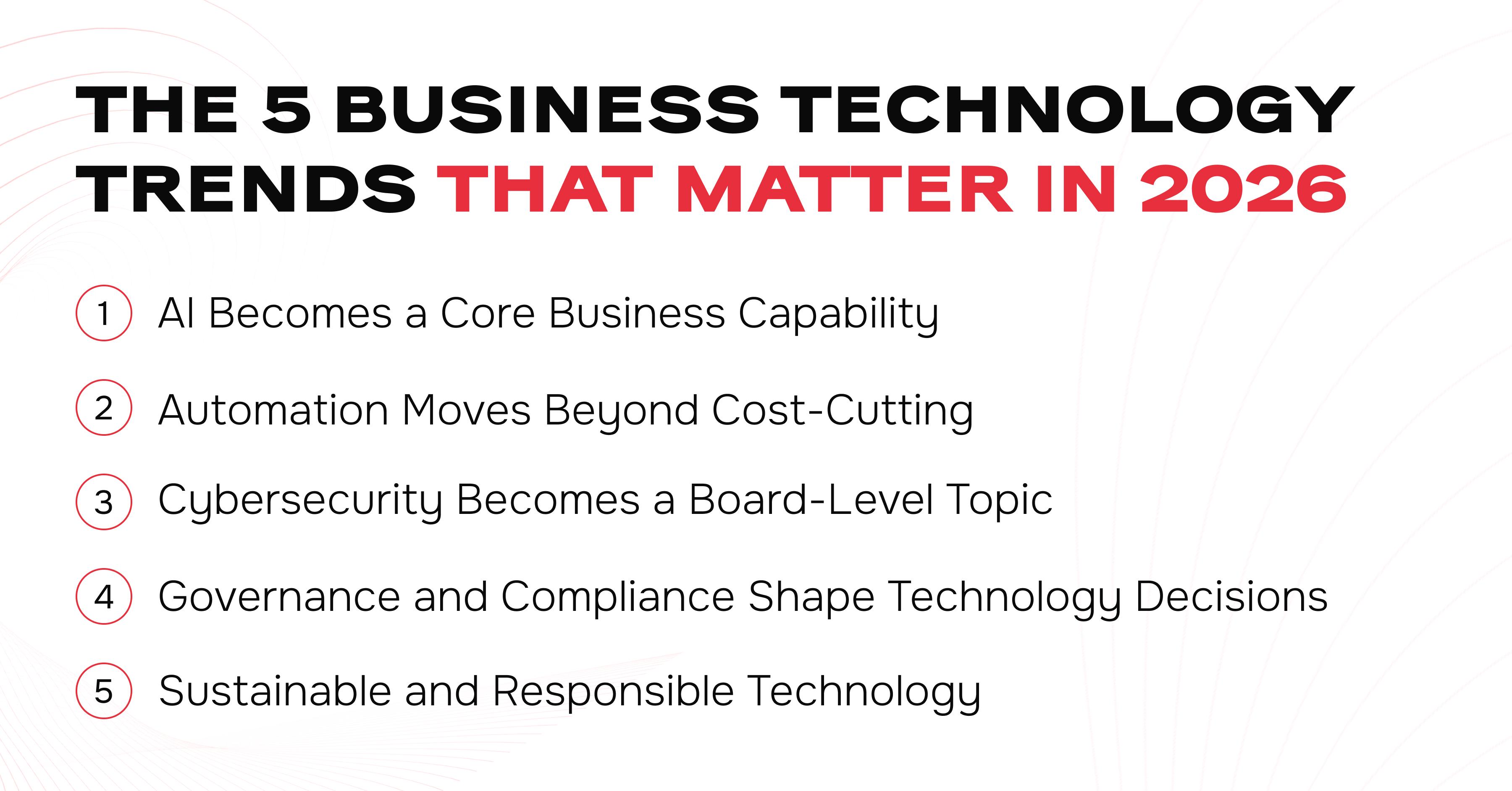
Trend №1. AI Becomes a Core Business Capability
Surely, artificial intelligence ranks first in our selection of the best technology trends. Why is that? Just look at any official statistics related to the growth in the use of AI functions among enterprises worldwide. Its incredible popularity is due to a number of factors. Therefore, we recommend that you invest in artificial intelligence technology today to gain a concrete advantage tomorrow!
From AI Experiments to Real Business Workflows
Early AI pilots tended to be a concept that worked, but did not alter the manner in which work is accomplished. In 2026, this movement is toward workflow-first design. What do we mean? Groups begin with a quantifiable business outcome, and incorporate models into systems already used by people, e.g., CRM, ERP, service desks, and analytics.
Operational discipline is different with this wave. There is defined leadership of ownership, data readiness, and metrics of success prior to rollout. They also invest in integration and change management, thus AI does not lie in a dashboard.
Generative AI in Everyday Operations
Generative AI is becoming part of everyday life since it can shorten the cycle time, standardize quality, and help employees deal with complexity without increasing the workforce. The most effective outcomes are achieved when the copilots are linked to the accepted data sources and are governed by clear rules. Here are some tips:
- Prepare draft customer responses and sales offers in approved language and offers.
- Concisely recap meetings, tickets, and calls into next steps.
- Create first pass reports, dashboard narratives, and variance explanations.
- Code review notes and documentation
A reward is not cool output, but is little or no handoff and quicker decisions. When teams quantify impact (time saved, defect reduction, resolution speed), they can increase the use cases that keep delivering good results.
Why AI Governance is Now a Business Requirement
What about governance frameworks for AI? Clear rules for data access, human review, monitoring, and vendor accountability prevent costly errors, leakage, and shadow AI sprawl. Strong governance also speeds adoption by making approvals predictable and risks visible.


Trend №2. Automation Moves Beyond Cost-Cutting
The next technology trend we want to share with you is about automation. It stops being a simple cost-cutting tactic and becomes a growth and resilience strategy. Companies are using it to reduce delays, improve quality, and keep operations stable even when teams, demand, or supply conditions shift quickly.
Automation as a Productivity Multiplier
The largest automation victors are no longer a reduction in the number but an increase in capacity. By eliminating repetitive handoffs, teams regain time to spend on work that requires judgment, such as exception handling, customer relationship management, and optimization.
Consistency is also improved by automation! So, the presence of standardized steps minimizes the error rate, reduces onboarding time, and makes the results more predictable by region and team. By linking automation to objective metrics (cycle time, rework rate, SLA performance), leaders can scale effective automation and remove scripts that add complexity.
Rebuilding Workflows, Not Just Speeding Them Up
Rushing a broken process only brings with it the wrong outcome in a shorter time. In 2026, leaders re-architect the workflow end-to-end: they eliminate unnecessary approvals, specify decision rules, and streamline data feeds to make them automatable. It is aimed at a cleaner workflow, reduced exceptions, a clear sense of ownership, and an automation that avoids mistakes rather than one that silently increases them.
Human + AI Collaboration in Business Processes
The most preferable processes embrace AI speed equalizing with human judgment. Triage, drafting, and pattern detection are handled by AI, whereas high-impact decisions and edge cases are solved by people. Many teams also rely on IT staff augmentation services to add experienced specialists for implementation, governance, and ongoing optimization.
Trend №3. Cybersecurity Becomes a Board-Level Topic
Cybersecurity is no longer just an IT concern. It’s a business survival issue. Ransomware, supply-chain breaches, and regulatory exposure can shut down operations fast, making risk ownership a boardroom conversation, not a technical sidebar.
Why Traditional Security Models are No Longer Enough
Security presupposes that you can effectively distinguish between the inside and the outside. The latter fails when work occurs through both cloud applications, contractors, APIs and partners. Attackers use identity, misconfigurations, and third-party access to bypass a firewall.
In the meantime, the incidents are more frequent and deliberate. Automation is employed to scan vulnerabilities, phish at scale, and conduct lateral movement after gaining access through credentials by threat actors.
Cybersecurity in AI-driven Environments
Artificial intelligence increases the attack surface in imperceptible fashions. Prompts and logs, or inadequately managed retrieval systems, can reveal sensitive information in models, and opponents can alter inputs to alter results. The security teams in 2026 are interested in access controls to AI sources of data, immediate and output observation.
Data Protection, Privacy, and Trust
The companies are judged by the customers and regulators based on their approach to data rather than their claims. Highly secure encryption, retention restrictions, and audit trails will mitigate the effect of breaches, whereas transparent consent and purpose restrictions preserve privacy. Trust is a competitive resource- gained by systematic controls and not advertising.
Trend №4. Governance and Compliance Shape Technology Decisions
Governance and compliance aren’t just legal checkboxes. We mean they directly shape what gets built, bought, and deployed. As AI, data sharing, and third-party platforms expand, companies need clear rules to move fast without creating costly risk. Let's talk more about it!
Governance Frameworks as Enablers, Not Blockers
Modern governance works when it reduces uncertainty. Instead of long approval cycles, strong frameworks provide reusable patterns. So, teams know the “safe way” to ship from day one.
It also aligns stakeholders early. Legal, security, and product teams agree on thresholds and escalation paths before a project goes live. That prevents last-minute rework, improves audit readiness, and makes vendor decisions cleaner. The result is faster delivery with fewer surprises, not slower delivery with more meetings.
Balancing Innovation With Compliance
The two can co-exist, where innovation and compliance are not added to delivery as an afterthought. This is aimed at maintaining simplicity of experimentation whilst putting guardrails around sensitive data, customer impact, and regulatory exposure.
- Categorize and limit access to confidential data.
- Establish human-in-the-loop rules in making high-impact decisions. Need model and vendor documentation (use cases, updates, incidents)
- Standardize logging, retention, and access control.
These guardrails enable teams to rapidly test ideas and scale only what passes the grade. Obedience becomes a means of safeguarding momentum, since the quickest way is the one that will not be overturned in the future.
Why Governance is Critical for Scalable Growth
Inequality becomes costly as companies grow. Redundant tools, unregulated streams of information, and unequal security are experienced. Governance is a clean-up in progress, as it standardizes controls, ownership, and decision-making rights across teams and regions. It minimizes risk, accelerates procurement and implementation, and develops trust to grow partnerships and automation with confidence.
Trend №5. Sustainable and Responsible Technology
And the last technology trend in this article is sustainability. It’s a performance standard. Energy use, hardware lifecycle, and data-center choices affect cost, resilience, and compliance, pushing leaders to treat sustainability as part of core tech decisions.
Sustainability as a Technology Strategy
Sustainability became a practical optimization problem. So, most modern companies are measuring energy and carbon across cloud usage, AI workloads, and device fleets, then redesigning architectures to reduce waste. FinOps and GreenOps practices help teams tie consumption to owners, budgets, and outcomes.
Procurement is changing, too. That's why enterprises favor vendors that can demonstrate transparency: reporting, renewable energy sourcing, and responsible supply chains. Longer refresh cycles, repairability, and smart asset management cut both emissions and spend, while reducing exposure to shortages and price swings.
Responsible AI and Long-term Business Value
We should also mention that responsible AI is moving from policy to economics. Bias, privacy leakage, and unreliable outputs create churn, legal risk, and rework. Companies design AI with clear accountability and explainability, and enable continuous monitoring for high-impact use cases. When AI is trustworthy, adoption rises and the value compounds through better decisions, not just faster ones.
Why Sustainability Matters for Enterprise Technology
What are the benefits? Sustainability strengthens enterprise technology by improving efficiency and resilience. Lower energy demand reduces operating costs and makes workloads easier to scale. Clear reporting supports customer and regulator expectations, while responsible sourcing protects continuity. Over time, sustainable choices become a competitive advantage because they reduce risk and waste simultaneously.
Some business owners might wonder if it's worth investing in the tech trends mentioned above right now. Is it profitable, and why is everyone talking about it? By implementing automation solutions, generative artificial intelligence, and improved cybersecurity measures, you increase the chances that your project will be a big hit before your competitors. After all, other companies are not sitting idle and may already be thinking about developing a strategy for applying some of these technology trends.
If you want to become No. 1 in your industry, seriously consider these tips and find a reliable partner. At Red Rocket Software, we follow IT trends and help companies develop AI agents, improve security, and implement automation features.
How we gathered these insights: To compile this 2026 trend report, the Red Rocket team analyzed over 40 internal case studies from the past year, cross-referenced data from industry leaders like Gartner and IEEE, and conducted internal workshops with our senior development leads. Our goal is to provide practical, non-hype insights for business leaders.
Ready to align your tech stack with 2026 trends? Don't wait for the future to happen to you. Get a Free Technology Audit from Red Rocket’s senior architects. We’ll analyze your current infrastructure and provide a 12-month modernization roadmap.
Frequently asked questions
How should businesses prioritize technology investments in 2026?

Companies should consider trends shaping the future before allocating their investment budgets for 2026. Business owners should pay attention and focus on generative AI, automation opportunities, and not forget about the constant strengthening of the cybersecurity aspect.
Is generative AI a must-have for all businesses in 2026?

What are the biggest risks of adopting new technologies in 2026?
